The picks
Pick 1: For a bedroom or study
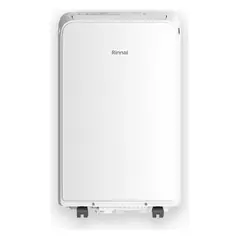
Image: Rinnai Rinnai Portable 2.6kW Wi-Fi air conditioner
Model RPC26MCWF
- Cooling capacity
- 2.6 kW
- Rated input power
- 1000 W
- Window kit
- Adjustable slider kit for window openings of 675 to 1250 mm
For a bedroom or study, the RPC26MCWF has 2.6 kW of cooling at a rated input power of 1000 W, and Rinnai states a room size for it, which the calculator sets beside yours. Rinnai is also the only maker we compared that states the window openings its kit fits, 675 to 1250 mm, and its duct extends to 1800 mm.
Worth knowing Rinnai lists a maximum input power of 1200 W as well as its rated input power of 1000 W. Its page gives the room size two ways, 10 to 20 in its heading and 11 to 20 in its specifications; we use the specifications. It is cooling only, and weighs 28.5 kg.
At the running-cost calculator's starting price (27.47c/kWh, Victoria: Jemena area): about 27c an hour at full rated input power.
Sources: [8] [9] [5] [2] [7] [16] [18] [19] [21] [23] [25] [27] [28]
Pick 2: For a larger room, moved between rooms
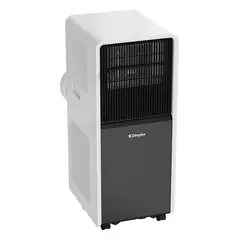
Image: Dimplex Dimplex recycled portable air conditioner with Wi-Fi
Model DCP40EB
- Cooling capacity
- 3.8 kW
- Weight
- 24.5 kg
- Smallest room (maker's book)
- 15 m²
If your room is larger and the unit has to move between rooms, the DCP40EB has 3.8 kW of cooling and weighs 24.5 kg, the lightest of the models of 3.5 kW or more whose maker gives a weight. Dimplex states a room size for it, which the calculator sets beside yours, and its specification sheet says it is self evaporative.
Worth knowing Dimplex states no rated input power for it, so its running cost cannot be worked out from the maker's figures. Its window slider kit comes with no stated size, and its book asks for at least 50 cm from the nearest wall and no extension lead. Dimplex states at most 65 dB(A).
Pick 3: For a living area
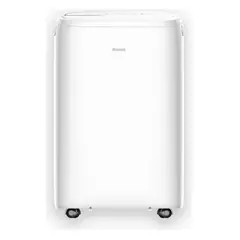
Image: Rinnai Rinnai Portable 4.1kW Wi-Fi air conditioner
Model RPC41MCWF
- Cooling capacity
- 4.1 kW
- Rated input power
- 1640 W
- Window kit
- Adjustable slider kit for window openings of 675 to 1250 mm
For a living area, Rinnai states a larger room size for the RPC41MCWF than any other maker we compared states for any model, and its 4.1 kW is the highest cooling capacity stated, shared with Olimpia Splendid's Serenity 14 and Omega Altise's OAPC41W. Its rated input power is 1640 W, and its window kit fits openings of 675 to 1250 mm.
Worth knowing At 36.5 kg it is the heaviest of the models whose maker gives a weight. Rinnai also lists a maximum input power of 1700 W, and it is cooling only.
At the running-cost calculator's starting price (27.47c/kWh, Victoria: Jemena area): about 45c an hour at full rated input power.
Sources: [10] [11] [8] [13] [15] [17] [19] [22] [1] [3] [4] [6] [20] [24] [26]
Pick 4: For heating as well as cooling
Goldair Platinum Wi-Fi multi-season portable air conditioner
Model GPPAC300
- Heating
- Yes, 2.7 kW
- Cooling capacity
- 3.53 kW
- Smallest room (maker's book)
- 13 m²
- Room size
- Maker states no room size
If you want one unit for summer and winter, the GPPAC300 is the only model we compared whose maker states a heating output: 2.7 kW, with 3.53 kW of cooling. Goldair says it removes up to 28 L of moisture a day in dehumidifier mode, and it has Wi-Fi control.
Worth knowing Goldair states no room size and no rated input power for it, so the calculator cannot set your room beside it and its running cost cannot be worked out from the maker's figures. Its adjustable window kit comes with no stated size, and it weighs 35.1 kg.
Sources: [26] [27] [8] [10] [28] [16] [20] [22] [24] [3] [4] [1] [6] [17] [19]
Compare the specs
Specifications from each manufacturer's own pages, linked under each pick below.
| Spec |  Rinnai RPC26MCWF For a bedroom or study |  Dimplex DCP40EB For a larger room, moved between rooms |  Rinnai RPC41MCWF For a living area | Goldair GPPAC300 For heating as well as cooling |
|---|---|---|---|---|
| Cooling capacity | 2.6 kW | 3.8 kW | 4.1 kW | 3.53 kW |
| Rated input power | 1000 W | Not stated | 1640 W | Not stated |
| Noise (maker) | 64 dB(A) | ≤65 dB(A) | 64 dB(A) | Not stated |
| Smallest room (maker's book) | 8 m² | 15 m² | 12 m² | 13 m² |
| Exhaust hose length | 1800 mm | Not stated | 1800 mm | Not stated |
| Window kit | Adjustable slider kit for window openings of 675 to 1250 mm | Window slider kit; no size stated | Adjustable slider kit for window openings of 675 to 1250 mm | Adjustable window kit; no size stated |
| Heating | No, cooling only | No; its book lists cool, dry and fan | No, cooling only | Yes, 2.7 kW |
| Weight | 28.5 kg | 24.5 kg | 36.5 kg | 35.1 kg |
| Size | 710 x 415 x 345 mm (H x W x D) | 285 x 335 x 698 mm (W x D x H) | 802 x 493 x 415 mm (H x W x D) | H 70.5 x W 45 x D 34 cm |
| Room size | Maker rates it for rooms of 11 to 20 m² | Maker rates it for rooms of 18 to 26 m² | Maker rates it for rooms of 13 to 30 m² | Maker states no room size |
Swipe the table sideways to see all 4 picks.
Not marked, because the best figure depends on your needs: Cooling capacity, Rated input power, Noise (maker), Smallest room (maker's book), Exhaust hose length, Window kit, Heating, Weight, Size.
Is your room within the size each maker states?
Room size check
Your room's floor area, set beside the room size each pick's maker states for its own model. This guide gives no size of its own. Nothing you type leaves this page.
Running cost calculator
What one model costs to run: its rated power, how long and how often you use it (your own figures; this guide gives no default), and your electricity price. Nothing you type leaves this page.
Will it vent through your window? The hose, the kit and the smallest room
Every model whose maker shows its parts vents its hot air through one exhaust hose (TCL calls it a single duct), and none of the 15 is described by its maker as a two-hose model. So what decides whether one suits your home is how that hose meets your window. Rinnai is the only maker we compared to state the window openings its kit fits: 675 to 1250 mm for the RPC26MCWF and RPC41MCWF, whose duct extends to 1800 mm. De'Longhi lists a hose of 1200 mm for the PACES72CLASSIC and 1250 mm for the PACEM82K, PACEM93KSILENT and PACAP140IGENTLEJET; its book for the PACES72CLASSIC also offers a 150 mm hole through a wall or window for a semi-permanent fit. Goldair's book for the GCPAC200 gives a hose of 280 to 1500 mm and says you may need a glazier to cut a hole in your window pane for its hose clip. Dimplex, Olimpia Splendid and Omega Altise, and Goldair for the GPPAC300, supply a slider or adjustable kit but state no size for it, so measure your window before you buy. Many of the books also set a smallest room the unit may be installed, used and stored in, a safety rule separate from the room size it cools; the spec table gives it for each pick.
Sources: [28] [5] [9] [11] [1] [2] [3] [4] [6] [25] [27] [16] [18] [19] [21] [23]
What to weigh up
Cooling capacity
The cooling output the maker states, in kilowatts. The models we compared run from 2.06 kW, Goldair's GCPAC200, to 4.1 kW, Rinnai's RPC41MCWF, Olimpia Splendid's Serenity 14 and Omega Altise's OAPC41W. It is not a room size: where a maker states one, it is a separate figure.
Noise (maker)
The sound level the maker states, in dB(A). Makers measure at different fan speeds and distances and most do not say which, so compare these only as each maker's own figure. Olimpia Splendid and Omega Altise's OAPC9W give a sound power level instead, which the table names as such: it is a different measure and does not compare with the rest.
Types explained
Self-evaporating, or drained
These units take water out of the air as they cool. Dimplex's specification sheets call the DCP26EB and DCP40EB self evaporative, Goldair says the same of the GPPAC300, Rinnai says no water-emptying is required, and De'Longhi's book for the PACEM models describes an auto-evaporation feature. In very humid weather, Dimplex and Rinnai say the unit may still need draining through a hose.
Fitting and space
Room around it
Leave space around the unit for air to move. De'Longhi asks for 60 cm from walls and obstacles for the PACEM82K, PACEM93KSILENT and PACES72CLASSIC. Rinnai asks for 500 mm for the RPC26MCWF and RPC41MCWF. Dimplex asks for 50 cm for the DCP26EB and DCP40EB, and Omega Altise 50 cm for the OAPC9W. Olimpia Splendid asks for 45 cm around and above the PAC9000, and Goldair for 300 mm for the GCPAC200 and GPPAC300.
The power point
Rinnai says not to use power boards or double adaptors, and Dimplex and Omega Altise say not to use an extension lead.
The smallest room
Dimplex, Rinnai, Omega Altise and Goldair books set a floor area the unit must be installed, used and stored in, and Dimplex ties it to the flammable R290 refrigerant these units use. It is separate from the room size the unit cools: Dimplex states a room size for the DCP26EB that starts below the smallest room its book allows. Check both against your room; the spec table gives the smallest room for each pick.
Every model compared
Show all 15 models
| Model | Pick, or why not |
|---|---|
 | |
 | |
 | |
 | De'Longhi gives the PACAP140IGENTLEJET's room size as a volume, not a floor area, so the calculator cannot set your floor area beside it. For a larger room we picked the Dimplex DCP40EB, which has more cooling, 3.8 kW against 3.7 kW, and weighs less, 24.5 kg against 31.291 kg, with a floor area stated. |
| Pick 1: For a bedroom or study |
| Pick 3: For a living area |
 | Dimplex states a room size for the DCP26EB that starts below the smallest room its own book allows it to be installed in, so we picked the Rinnai RPC26MCWF for a bedroom or study, whose maker also states a rated input power and the window openings its kit fits. At 21.5 kg the DCP26EB is lighter than the Rinnai's 28.5 kg. |
| Pick 2: For a larger room, moved between rooms |
 | Olimpia Splendid's page prints the PAC9000's cooling capacity with a misprint and states no rated input power, and the smallest-room chart in its book could not be read. At 20.8 kg it is the lightest of the models whose maker gives a weight. Sources: [17] [18] [1] [3] [4] [6] [8] [10] [13] [15] [19] [20] [22] [24] [26] |
 | |
 | |
 | |
| GoldairGCPAC200 | |
| GoldairGPPAC300 | Pick 4: For heating as well as cooling |
| TCLTAC-09CPB-MZ | TCL's page for the TAC-09CPB-MZ states its 2.6 kW cooling capacity and a single duct, but no rated input power, room size, hose or window kit size, and links no book we could read. Source: [28] |
Using it well
Keep the cool in
De'Longhi's book for the PACEM82K and PACEM93KSILENT asks you to close the room's windows and doors, and, when the unit is set up semi-permanently, to leave a door open by as little as 1 cm for ventilation. De'Longhi and Rinnai both ask you to draw curtains or blinds against the sun, and Rinnai says not to put the unit or its window slider in direct sunlight.
Care and upkeep
The filter
Rinnai asks for its filters to be cleaned at least once every two weeks. De'Longhi asks for the filter to be cleaned at the end of the season and left to dry completely before it goes back in.
Moving and storing it
De'Longhi says never to carry the PACEM82K or PACEM93KSILENT upside down or on its side; if that happens, wait 6 hours before turning it on, and 24 hours is recommended. At the end of the season it asks you to drain the water completely.
Source: [5]
Questions readers ask
What brand of portable air conditioner is the best?
No one brand leads on every figure the makers publish, so we picked by room and need, not by brand. Of the seven brands we compared, Rinnai is the only one to state, for both of its models, a room size, a rated input power, the smallest room the book allows and the window openings its kit fits. Dimplex states room sizes for both of its models, and Goldair's GPPAC300 is the only model that also heats.
What is the most effective portable air conditioner?
Makers state cooling capacity in kilowatts, and the highest stated among the models we compared is 4.1 kW, for the Rinnai RPC41MCWF, Olimpia Splendid Serenity 14 and Omega Altise OAPC41W. Of these, Rinnai states the largest room size. How well a unit cools also depends on the room: De'Longhi's book lists a unit not suited to its room as one reason it may not cool, and asks for windows and doors to be closed.
Is there a portable aircon that actually works?
The makers' books give the same conditions for a portable unit to cool well: the hot air goes outside through the exhaust hose, kept as short and straight as possible (Rinnai, Dimplex); the room's windows and doors are closed (De'Longhi); and the sun is kept out with curtains or blinds (De'Longhi, Rinnai). Rinnai adds that performance is best when the unit is matched to the room size, which is what the calculator above helps you check against each pick. Rinnai also says a portable may produce more indoor noise than a split system; where a maker states its sound level, the spec table shows it.
Is a Kmart portable air conditioner good?
No Kmart model is among the 15 we compared, so we cannot set one beside them. If you are looking at one, check the same things on its maker's page and book as for any other: the cooling capacity, the rated input power, a stated room size, the smallest room the book allows and what its window kit fits.
Portable air conditioner vs split system?
Rinnai, which sells both, lists the trade-offs on its portable air conditioner page. A portable needs no permanent installation, moves from room to room and suits renters, apartments and temporary spaces. But it must vent hot air through a window, takes up floor space, and may be noisier indoors than a split system.
Source: [8]
How much does it cost to run a portable air conditioner?
At its full rated input power and 27.47c/kWh, an hour costs about 22c for the De'Longhi PACES72CLASSIC (808 W) and about 45c for the Rinnai RPC41MCWF (1640 W), the lowest and highest rated input powers of the eight models that state one. A summer depends on your hours: enter them in the calculator above. It assumes the unit draws its rated input power the whole time it runs, so treat the result as the most it would cost.
How we pick
- Models are those Australian stores were selling when the guide was researched, from at least five brands where the category allows.
- Sizes, capacities and power come from each maker's own page, specification sheet or instruction book.
- Energy and water figures come from the government rating labels, as each maker states them.
- Each pick is named for a buyer or a need, with at most two picks from any one brand, and no star ratings, scores or awards of our own.
- Every source is listed with the date it was read, and a second reading checks the guide against its sources.
Sources
- De'Longhi Australia, Pinguino Compact Portable Air Conditioner, 2.1 kW, PACES72CLASSIC, read .
- De'Longhi, PAC ES72 instructions for use (multilingual), read .
- De'Longhi Australia, Pinguino Portable Air Conditioner, 2.4 kW, PACEM82K, read .
- De'Longhi Australia, Pinguino Portable Air Conditioner, 2.6 kW, PACEM93KSILENT, read .
- De'Longhi, PAC EM K instructions for use, read .
- De'Longhi Australia, Pinguino GentleJet Portable Air Conditioner, 3.7 kW, PACAP140IGENTLEJET, read .
- De'Longhi, Pinguino GentleJet instructions for use, read .
- Rinnai Australia, Rinnai Portable 2.6kW (RPC26MCWF), read .
- Rinnai Australia, 2.6kW Portable Air Conditioner operation and installation manual, read .
- Rinnai Australia, Rinnai Portable 4.1kW (RPC41MCWF), read .
- Rinnai Australia, 4.1kW Portable Air Conditioner operation and installation manual, read .
- Dimplex Australia, 2.6kW Recycled Portable Air Conditioner w/ Wi-Fi & Dehumidifier (DCP26EB), read .
- Dimplex Australia, DCP26EB specification sheet, read .
- Dimplex Australia, 3.8kW Recycled Portable Air Conditioner w/ Wi-Fi & Dehumidifier (DCP40EB), read .
- Dimplex Australia, DCP40EB specification sheet, read .
- Dimplex Australia, Instruction manual, portable AC DCP26EB, DCP33EB and DCP40EB, read .
- Olimpia Splendid Australia, PAC9000, read .
- Olimpia Splendid Australia, PAC9000 instruction manual, read .
- Olimpia Splendid Australia, Serenity 14, read .
- Omega Altise, Portable Air Conditioner OAPC9W, read .
- Omega Altise, OAPC9W instruction manual, read .
- Omega Altise, Portable Air Conditioner OAPC41W, read .
- Omega Altise, OAPC41W instruction manual, read .
- Goldair, 2.06kW Portable Air Conditioner GCPAC200, read .
- Goldair, GCPAC200 instruction booklet, read .
- Goldair, Platinum Smart Wi-Fi 3.50kW Multi-Season Portable Air Conditioner, read .
- Goldair, GPPAC300 instruction booklet, read .
- TCL Australia, TAC-09CPB-MZ 2.6KW Portable Air Conditioner, read .
- Appliances Online, Portable air conditioners (category page), read .
- JB Hi-Fi, Portable air conditioners (category page), read .
- TCL, TAC-09CPB-MZ specifications (the data file the product page loads its specification table from), read .
- Essential Services Commission (Victoria), Victorian Default Offer 2026-27, domestic flat tariffs, read .
- Australian Energy Regulator, The Default Market Offer, DMO tariff caps 2026-27, read .
- Aurora Energy (Tasmanian Government-owned electricity retailer), What is a kilowatt-hour (kWh)?, read .
Related guides
Every guide in this area, what each weighs up and the calculators it carries: Heating and cooling.